People 2012
The man who discovered an eleven-sided shape, and then eleven found him
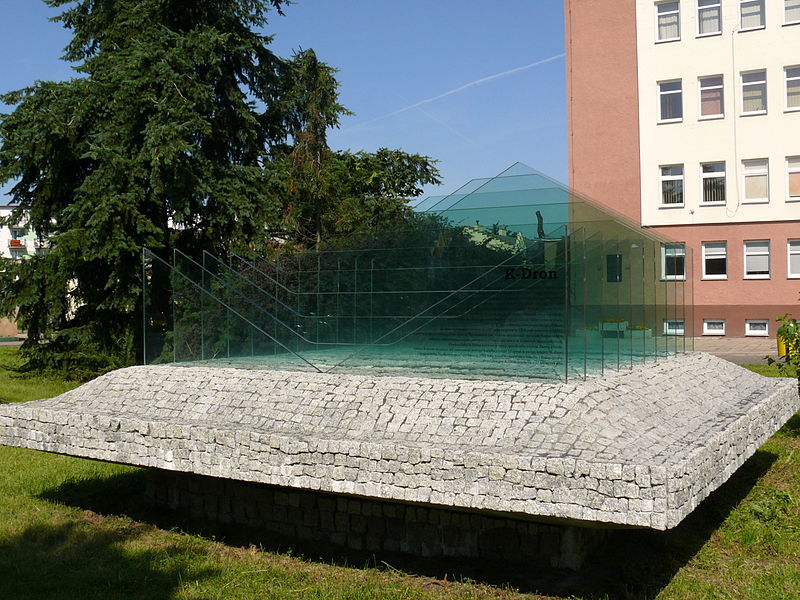
In January 1985 a Polish artist living in New York, Janusz Kapusta, was preparing a gallery show and stumbled on a shape nobody had described before. It is a solid with eleven faces, and two of them, placed top to top, make a cube. He called it the K-dron. It has since become a patent, a children’s play, a monument in Koło, near the village where he was born, a hollow brick and a bottle: 168 uses in all, by his own count. The brick came first, and his friend, the cartoonist Andrzej Czeczot, named it the kapustak: in Polish kapusta is a cabbage and pustak a hollow brick. When the monument in Koło was unveiled in 2009, he was working on a K-dron bottle, and said he finally had an answer for everyone who asks what the shape is for: so that you can have a drink. How the shape works is here.
Then, he says, the number started to keep him company.
“Take the number 11. The K-dron has 11 faces. In general, 11 became important to me. It began to accompany me. I just suddenly feel I have to turn around, and there it is: an eleven. Or a multiple of it: 22, 33, 44.”
He tells a story about coming back from a conference with a woman and a man, from Texas he thinks. The man was driving them to the airport and the woman was fretting that they would miss the flight. Relax, we’ll make it, said the Texan. How can you be so sure? she asked. Because it was 11:11 when we left.
“When one person does that, you can say he is a madman. But when a second one appears, the matter looks a little different.”
That, Kapusta says, was when it dawned on him that eleven was not only his private quirk.
There is more. A contest he ran in Poland for objects based on the K-dron was won by a young woman who cut away one of its eleven faces, the rhombus, and joined the rest into a handbag. The prizes were handed out at eleven o’clock. An hour later he met a student who had travelled from Gdańsk to show him an armchair he had built from the K-dron by throwing away every face except the rhombus. She removed the one face; he kept only that one. On the same day. And eleven, after all, is one and one.
He read Tarkovsky’s diaries and found the director, terrified of flying, unable to board a plane to Sweden until a car with a 13 in its number plate drove past. For me it is eleven, for him it was thirteen. Kapusta rented one of Tarkovsky’s films. It ended at 1:11. Then the credits and the music ran, and the whole thing finished at exactly 1:13. His eleven and Tarkovsky’s thirteen, joined.
And then, to the interviewer’s worried face:
“Don’t look so troubled, I don’t say all of this entirely seriously. I only want to say: if the cosmos wanted to communicate, how would it do it? It says something, and I don’t understand. So I propose a code: show me an eleven.”
Kapusta has drawn for The New York Times, and has been an architect, a set designer and the discoverer of what he calls unknown rules of the golden ratio. In 2025 he received the Order of the White Eagle, Poland’s highest honour.
And his code for the cosmos is the best description of this site we know: show me an eleven.
Sources
- Gazeta Wyborcza, Magazyn: 'Najlepsza Polska to ja i żona' (interview with Janusz Kapusta, 2012) (archived copy) — in Polish
- K-dron, Wikipedia
- LM.pl, 'K-dron: można się nawet napić' (17 September 2009), on the unveiling of the K-dron monument in Koło (archived copy) — in Polish
- Janusz Kapusta, Wikipedia — in Polish; born in Zalesie near Koło
- President of Poland, 'Najwyższe odznaczenia państwowe dla Janusza Kapusty i Jerzego Kropiwnickiego' (3 May 2025) — in Polish; the Order of the White Eagle