Math & science 1995
According to M-theory, the universe has eleven dimensions
Read aloud by ElevenLabs, whose lucky number is 11.
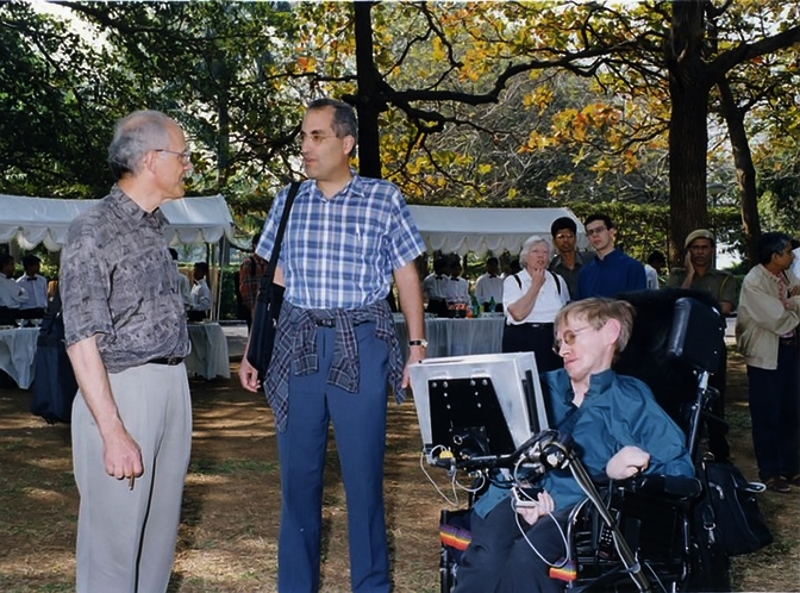 In the photo, three physicists outdoors under trees in autumn colours, in 2001. On the left, the grey-haired David Gross; in the middle, Edward Witten in a checked shirt; on the right, Stephen Hawking in his wheelchair, with the screen of his speech computer in front of him. Behind them, people and white tents.
In 1995 the physicist Edward Witten proposed that the five competing versions of string theory were really views of one underlying theory, which he called M-theory. It only works if spacetime has exactly eleven dimensions: the three we walk around in, time, and seven more curled up too small to see.
Witten said the M could stand for “magic, mystery or membrane”, as you like. And eleven is not an arbitrary choice: in 1978 the physicist Werner Nahm showed that eleven is the largest number of dimensions in which a theory of this kind can work at all. Physics, it seems, also goes up to eleven.
Nobody has yet found a way to test M-theory. But if it is right, then everything, including the clock you keep glancing at, is built on an eleven.
Sources
- M-theory, Wikipedia — Witten's announcement in 1995, and what the M stands for
- Eleven-dimensional supergravity, Wikipedia — Werner Nahm (1978), eleven as the highest number of dimensions