Beliefs 1900s onward
In numerology, 11 is a 'master number'
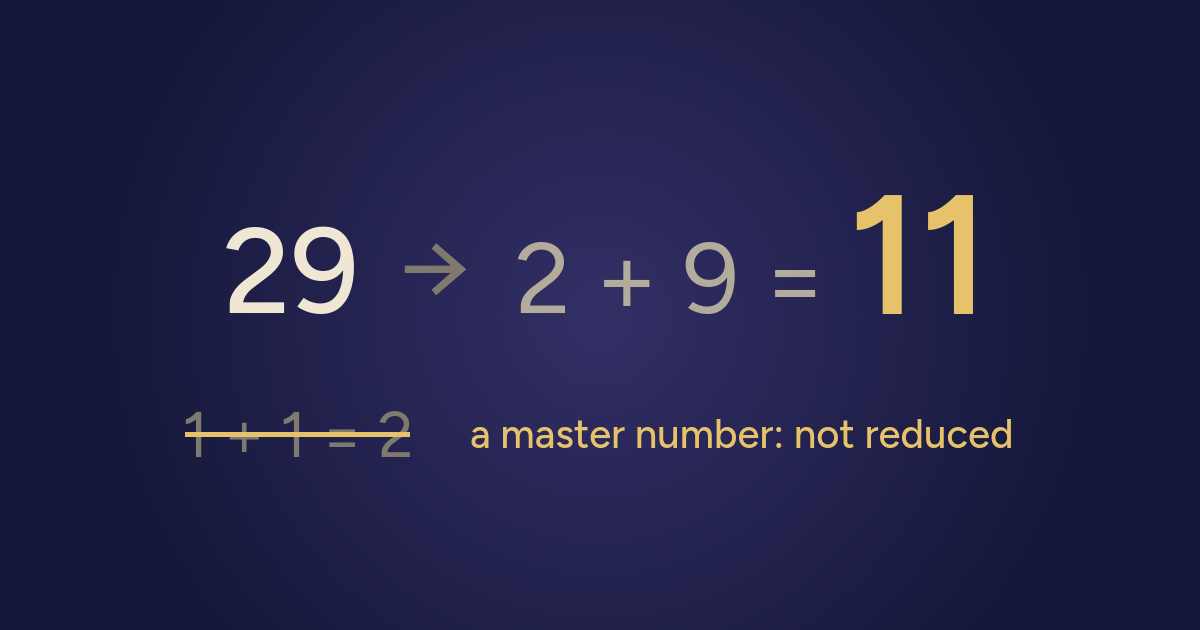
Numerology, the belief that numbers carry hidden meanings and influence lives, usually reduces every number to a single digit: 29 becomes 2 + 9 = 11, and 11 becomes 1 + 1 = 2. But most numerologists make an exception for 11 and 22, and many also for 33. These are the “master numbers”, and they are not reduced, because they are held to carry a power of their own. The idea is about a century old: the American numerologist L. Dow Balliett introduced it in the early 1900s, and her student Florence Campbell set it down as a rule in 1931.
Eleven, in this tradition, is the number of intuition, sensitivity and insight: the visionary, the person who feels things before they can explain them, sometimes at the cost of nerves and doubt. It is described as a doorway, two ones standing side by side like pillars.
You can try it on yourself. Numerologists call it your life path number: write out your date of birth, add up all its digits, then add up the digits of the result, and keep going until one digit is left. But if you land on 11 on the way, you stop there. Born on 9 September 1982? 9 + 9 + 1 + 9 + 8 + 2 = 38, and 3 + 8 = 11: a life path 11.
Worked out in your browser. Nothing is sent or saved.
None of this is science, and this site does not pretend it is. It is filed here under Beliefs because many people hold it, and because if you have ever been told by a numerologist that your “life path” is 11, you probably remember exactly how it felt.
Sources
- Numerology, Wikipedia — what numerology is
- Catherine Yronwode, 'Books About Numerology and Number Divination' (archived copy) — L. Dow Balliett as the originator of the master numbers 11 and 22; Florence Campbell's book (1931)
- Florence Campbell, 'Your Days Are Numbered' (1931), Internet Archive
- Hans Decoz, 'Master Numbers 11, 22, 33' (archived copy) — a numerologist on what 11 means
- Numerologist.com, 'Master Number 11' (archived copy)